$2.8B+
Potential investment pipeline
Across 8 priority sectors
$2.8 billion in potential investment pipeline. Nigeria House Davos 2026 established Nigeria's first sovereign pavilion on the Davos Promenade during the World Economic Forum's 56th Annual Meeting. Over five days it convened leaders from more than 50 countries and turned visibility into a structured investment pipeline.
Potential investment pipeline
Across 8 priority sectors
Strategic partnership meetings
Pre-qualified Deal Room sessions
Deal Room follow-up rate
Every meeting has an owner and a next step
Potential jobs
15,000 direct and 45,000 indirect
Projected 5-year tax revenue
$125M corporate and $45M employment
Attendees hosted
From more than 50 countries
Verified digital views
Combined audience reach
Digital, broadcast, print and institutional
Verified media placements
Government participation, private sector sponsorship, strategic partnerships, content programming and investment facilitation.
High-level forums, panel discussions, sector roundtables, Deal Room engagements, investor meetings, media outreach and policy dialogue.
Partnership discussions, investment leads, memoranda of understanding, media visibility and strategic relationships.
Increased investment interest, project development, trade opportunities, business expansion and stronger international partnerships.
Economic growth, job creation, higher government revenue and a stronger position for Nigeria in regional and global value chains.
$2.8B
Every meeting was sector-specific, had a named follow-up owner and a defined next step. The result: a 100% follow-up rate across all eight priority sectors.
Follow-up rate
Potential direct jobs
Potential indirect jobs
5-year corporate tax
5-year employment tax
$1.5B
The Dubai Multi Commodities Centre engaged the Deal Room on Nigeria's solid minerals sector, as the energy transition drives global demand for lithium, cobalt, gold and other critical minerals.
Why it matters: DMCC runs one of the world's largest commodities exchanges and offers Nigeria a direct route to structured international trade in critical minerals.
$400M
A proposed blended finance facility to unlock agricultural investment, improve smallholder productivity and stimulate food systems transformation.
Why it matters: It would bring in foreign capital and drive domestic agricultural transformation, directly addressing food security under the Renewed Hope Agenda.
$500M
One of the largest consumer goods manufacturers in the world engaged on local manufacturing and supply chain localisation in Nigeria.
Why it matters: A market of more than 230 million people and a growing middle class gives manufacturing real scale, with a pathway to import substitution and job creation.
Pipeline, jobs and tax figures are potential outcomes identified through Nigeria House Davos 2026 engagements. They are not committed capital, executed transactions or guaranteed investments, and remain subject to due diligence, negotiation, regulatory approval and market conditions.
Dr. Ngozi Okonjo-Iweala
Director-General, WTO
Wamkele Mene
1st Secretary-General, AfCFTA Secretariat
Wale Tinubu, CON
Group CEO, Oando Plc
Richard Quest
CNN International Business Anchor
“Nigeria is open for business, ready for investment and committed to creating an enabling environment for enterprise to thrive.”
Verified media placements
Verified digital views
Estimated combined reach
Coverage included CNN International, Arise News, Channels Television, Forbes Africa, ThisDay, Punch, BusinessDay, The Guardian, The Nation, Leadership, Premium Times, Nairametrics, Ripples Nigeria, Independent, Nigerian Observer, Radio Nigeria, Eagle Online, State House.
Broadcast
Visibility via Richard Quest and international broadcast reach
Broadcast
Multiple flagship stories, including 'Nigeria House Davos drives deal flow'
Broadcast
Full opening ceremony coverage: 'Shettima formally unveils Nigeria House Davos'
Broadcast
Documentary-style feature on the public-private partnership model
The Nigeria Global Gateway Group (NGGG) was established to keep Davos momentum alive between editions. It gives Nigeria a year-round structure for investment facilitation, stakeholder engagement and deal conversion.
Phase 1 · 2026–2027
Establish the NGGG operating structure, make Nigeria House Davos an annual platform and build the founding investor ecosystem.
Phase 2 · 2027–2028
Strengthen private-sector leadership, launch Nigeria in Africa at WEF Africa and sustain engagement through the national electoral cycle.
Phase 3 · 2028–2029
Institutionalise deal rooms, set up co-investment frameworks with DFIs and sovereign funds and expand to UNGA, AIF, AEW and Mining Indaba.
Phase 4 · 2029–2030
Deepen Nigeria's global economic influence, publish sector intelligence and build investor confidence through reform communication.
Phase 5 · 2030–2031
Embed NGGG as a permanent national economic diplomacy platform with a long-term public-private sustainability framework.
Nigeria House Davos is not an event.
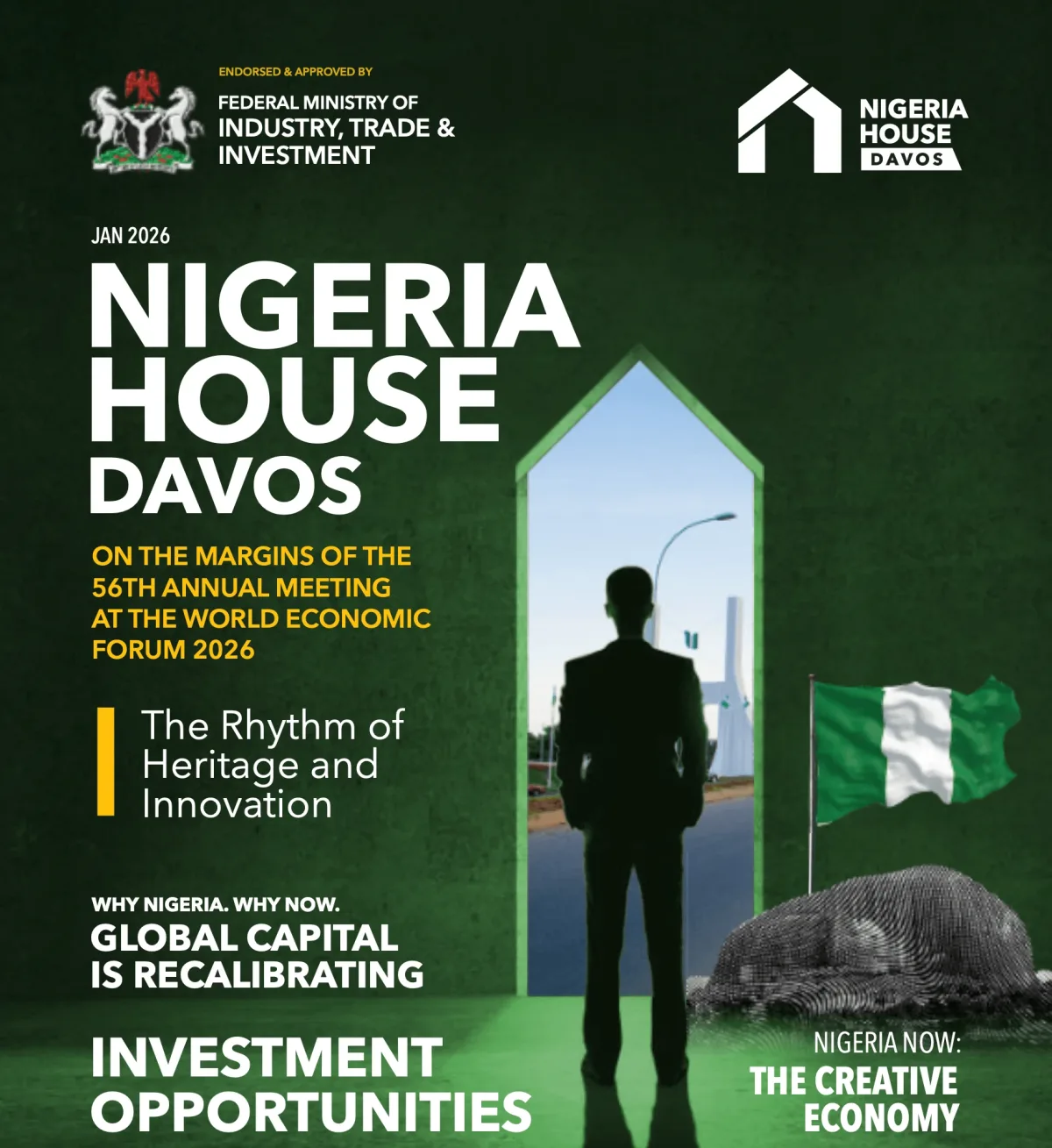
Download the complete 2026 Impact Report and the official Brochure. Both are free to read and share.
 PDF
PDFThe full assessment: Deal Room pipeline, media reach, impact framework and the road ahead.
PDF · 3.4 MB
 PDF
PDFThe visual story of Nigeria House Davos 2026: the pavilion, the programme and the people.
PDF · 13.3 MB